.png)
Close Cookie Popup
Cookie Settings
By clicking “Accept All Cookies”, you agree to the storing of cookies on your device to enhance site navigation, analyze site usage and assist in our marketing efforts. More info



Ecommerce brands have become extremely sophisticated at getting the right customer to their website.
Meta campaigns, Google Ads, influencers, affiliates and other channels can now target customers based on increasingly granular signals — their interests, behaviour, demographics, past purchases, geography and even the kind of content they engage with.
Brands also spend a significant amount of time understanding where their customers are coming from and what intent sits behind that traffic.
But there is a disconnect once the customer actually lands on the website.
The acquisition journey is personalised. The conversion journey is largely not.
Consider what a brand already knows before a customer even reaches checkout:
Yet once they reach the cart or checkout, these customers can end up seeing almost exactly the same experience.
The same banner. The same coupon. The same upsell. The same prepaid/COD messaging. The same checkout flow.
That's the missed opportunity.
Think about the amount of information a brand already has before a customer reaches checkout:
All of these are signals of intent.
But most of the time, those signals don't influence the final conversion experience.
It's almost like spending ₹1,000 to bring a customer into a store, knowing exactly what they came looking for, and then having the salesperson completely ignore that information.
Customers buying for themselves during a festival like this will lean ethnic. But when the same customer is buying a gift, they'll often flip to something more versatile: casual wear that works at the office or college, rather than another piece of ethnic wear the recipient may already have covered.
If your festive merchandising treats every purchase as an ethnic purchase, you're missing half the intent in your own cart.
Same brand. Same website. Same checkout infrastructure. But a different experience, based on intent.
This is where UTM-based personalisation + segmentation becomes interesting.
The UTM tells you why the customer came. Segmentation tells you who the customer is. Behaviour tells you what they are doing.
Together, they can tell you what the customer is likely to respond to.
From a generic checkout that processes transactions to a contextual checkout that responds to intent.
And I think that is the next interesting layer of ecommerce personalisation.
This is exactly the layer we're building at Shopflo using UTM-level intent, shopper identification through Shop Pass, and live segmentation to let checkout respond to context instead of treating every customer the same.
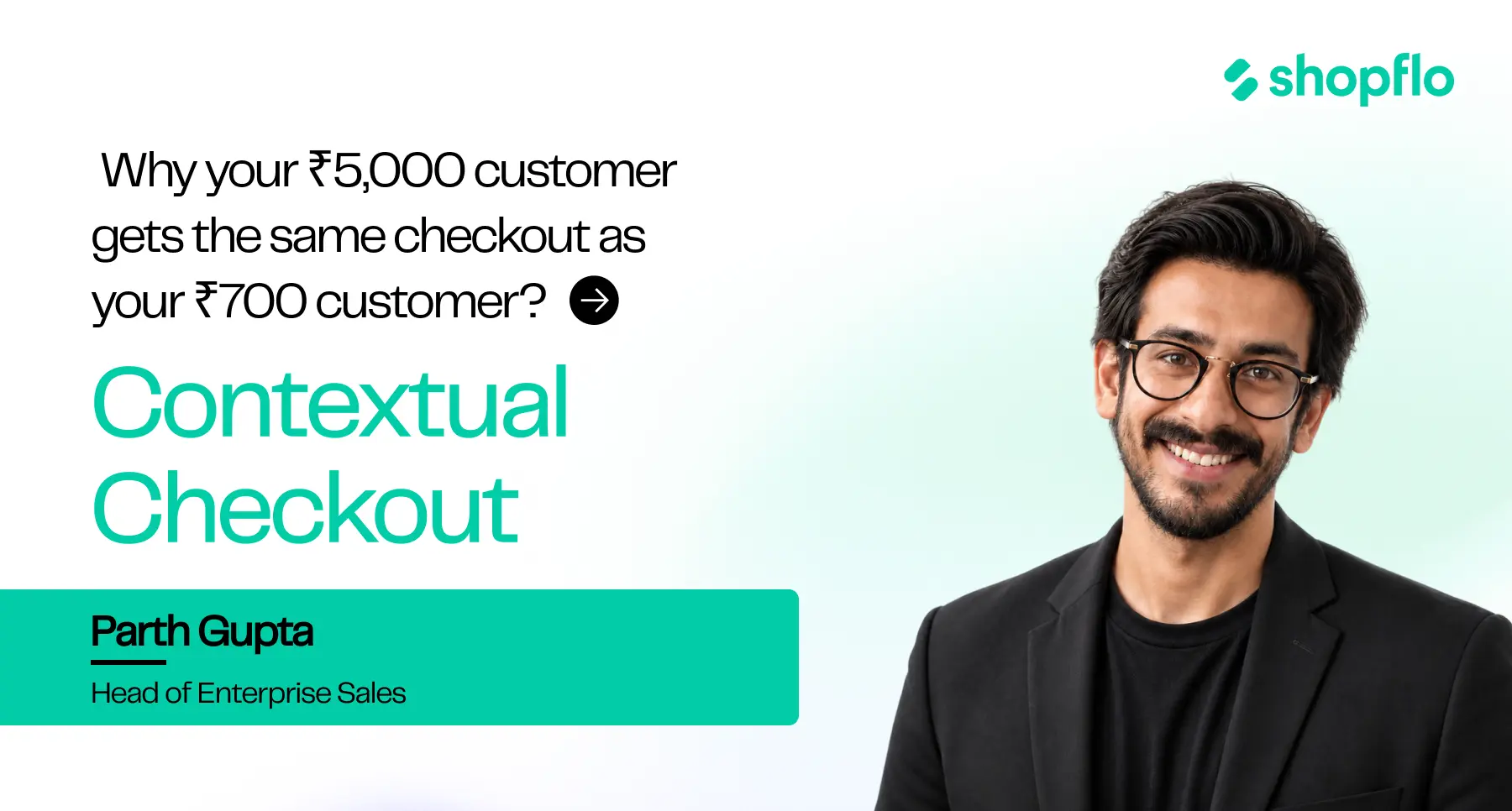
Parth Gupta is Head of Enterprise Sales at Shopflo, where he partners with enterprise D2C brands to help them unlock higher conversions, reduce drop-offs, and build a seamless checkout experience. Before Shopflo, he led the Emerging Business vertical at Cashfree Payments, managing a 30+ person sales team, with earlier roles at GoKwik and Evenflow. He is based in Bengaluru. Connect with Parth on LinkedIn.
